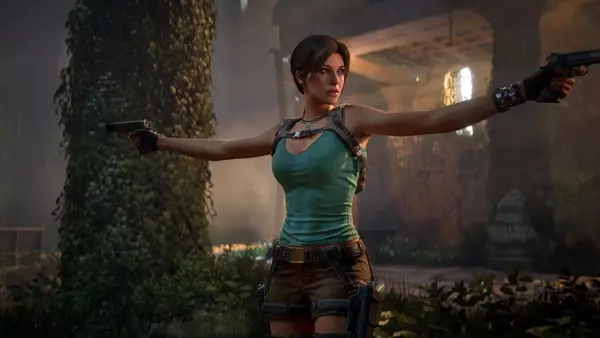

A new technique for rendering stunningly realistic visuals, known as Gaussian Splatting, is captivating the gaming world, offering a cost-effective alternative to traditional graphical approaches. This technology has become a personal fascination for scan artist Christoph Schindelar, who previously showcased its capabilities in a browser-based first-person shooter set in a scanned, abandoned environment. He delved into the intricacies of Gaussian Splatting, explaining its operation and diverse applications.
Schindelar, a former artist at Quixel, an Epic Games subsidiary celebrated for its extensive library of 3D scanned assets, defines Gaussian Splatting as an advanced method of capturing and rendering real-time 3D representations from photographs or videos. Unlike polygon-based rendering, it constructs scenes using millions of translucent 3D 'splats,' each possessing unique positional, size, orientation, opacity, and view-dependent characteristics. This technique is akin to photogrammetry but demands significantly fewer computational resources, allowing for rapid playback due to the GPU's primary task of projecting and blending these splats.
The accessibility of Gaussian Splatting makes it particularly appealing to independent creators, as it’s integrated into most major game engines, either natively or through plugins. Schindelar emphasized that while large studios are slow to adopt it, indie developers are at the forefront of innovation. The process involves meticulous scanning with high-resolution cameras, though the ideal resolution varies based on environment size and desired detail. Post-processing, or 'splat training,' involves optimizing these splats until the rendered scene precisely matches the original images, a procedure that can take several days. While high-end GPUs with ample VRAM are beneficial, cloud-based processing options are also available, democratizing access to this groundbreaking technology. Despite some limitations, such as baked-in lighting, Schindelar believes these can be mitigated through innovative production techniques, making Gaussian Splatting a promising tool for future game development.
The innovation represented by Gaussian Splatting exemplifies how technological advancements can empower creators and open new frontiers in digital art. Its potential to bring photorealistic experiences to a broader audience, even on less powerful devices, highlights a future where creative vision is less constrained by technical limitations. This progressive stride encourages a more vibrant and diverse landscape for interactive entertainment, pushing the boundaries of what is visually achievable in gaming.